Wednesday, June 11, 2014

Thursday, May 1, 2014
Posture Exercise for "Humpback" or Kyphosis

The first clues are often small. Your shoulder bag slides off more easily and your fitted cloths don’t feel right, as they’re not designed for rounded shoulders.
“Humpback” decreases lung capacity and, believe it or not, increases constipation. Your chest volume decreases as your back hunches forward. Your lungs start to fight for space with your other internal organs. Your breathing, digestion and kidney functions deteriorate. You just start feeling old.
“Humpback” or Kyphosis makes you old before your time, but it doesn’t have to happen. You can take action to prevent it. If you start early enough, weight bearing exercise and maintaining a habit of activating your stomach muscles whenever you are moving, may be sufficient. However for most people, a very targeted approach of exercise is necessary.
The BStrong4Life Strengthening System targets the specific muscles that support the spine and is extremely effective at returning an individual to a “normal spine”. Using full spine x-rays which have a computerized digital drawing of your spine compared to normal, we can monitor your progress.
Without the technology used in our strengthening equipment, it is extremely difficult, if not impossible, to improve the alignment of your spine without the BStrong4Life System. This system has only recently become available and can truly change the aging process with no medication and, no side-effects.
DEXA Scan (Bone Density Test) Frequently Asked Questions - Naperville, IL
The “gold standard” of bone mineral density testing is call a DEXA scan. It is encouraged for most people age 50 and above. If there is a family history of osteoporosis or an individual has health issues that would speed up bone loss, such as chemotherapy, a test should be taken at a younger age.
The test is often covered by your health insurance plan and is extremely easy to take. No needles, no undressing (as long as you don’t wear any metal) and a machines just passes over your body using a low-dose x-ray.
 We found a great synopsis of FAQ’s, frequently asked questions, that we encourage you take a look at! http://www.womensmedicine.org/frequently-asked-questions-about-bone-density-testing.html
The big question remains though! If I do have osteoporosis or it’s precursor, osteopenia, what do I do about it? Please take the time to investigate our BStrong4Life System which has been shown to reverse the effects of osteoporosis and increase bone mineral density.
What are the Symptoms of Osteoporosis?
If I have Osteoporosis, wouldn’t I know it?
No, not usually. Osteoporosis is often called “the silent disease” because it progresses slowly over time, without symptoms, until a fracture occurs.People may not know that they have osteoporosis until their bones become so weak that a sudden strain, bump or fall causes a fracture or a vertebra to collapse.
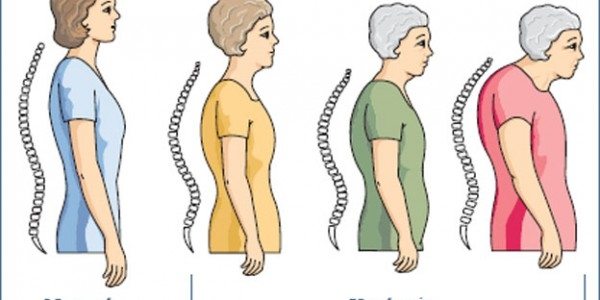 Collapsed
vertebrae may initially be felt or seen in the form of severe back
pain, loss of height, or spinal deformities such as kyphosis or stooped
posture.
Collapsed
vertebrae may initially be felt or seen in the form of severe back
pain, loss of height, or spinal deformities such as kyphosis or stooped
posture.For example, many people continue to assume height loss is a normal part of aging. However, it may be due to a collapse in the bones of the spine, called vertebrae, weakened by osteoporosis.
“Osteoporosis is a disease that one is unaware of until it makes a sound. And that sound is not really an audible sound. To me that sound was the sound of pain experienced when a bone breaks,” said Linda, a patient.
The National Osteoporosis Foundation advises everyone to routinely monitor their height and talk to their healthcare provider if they notice a loss of more than an inch.
This is where our BStrong4Life System has life changing effects. By strengthening the muscles that support your bones, we can improve your posture, increase your height and increase your bone density simultaneously.
Patients often don’t realize they have osteoporosis or are even at risk until they suffer a fracture – most commonly of the hip, spine or wrist – after a fall or from doing ordinary activities. At this point, they have already suffered the consequences of osteoporosis.
Subscribe to:
Comments (Atom)